

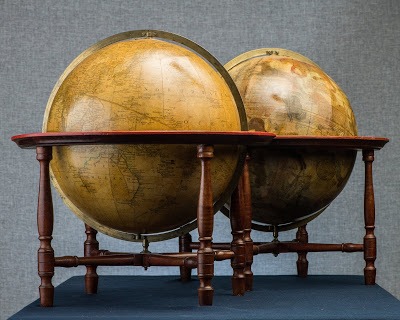
Did you know that the first globes made in the United States were made right here in Vermont in the 1800s?
Before we get to that part of the story, let’s go waaaaay back in time, all the way to 245 BC…
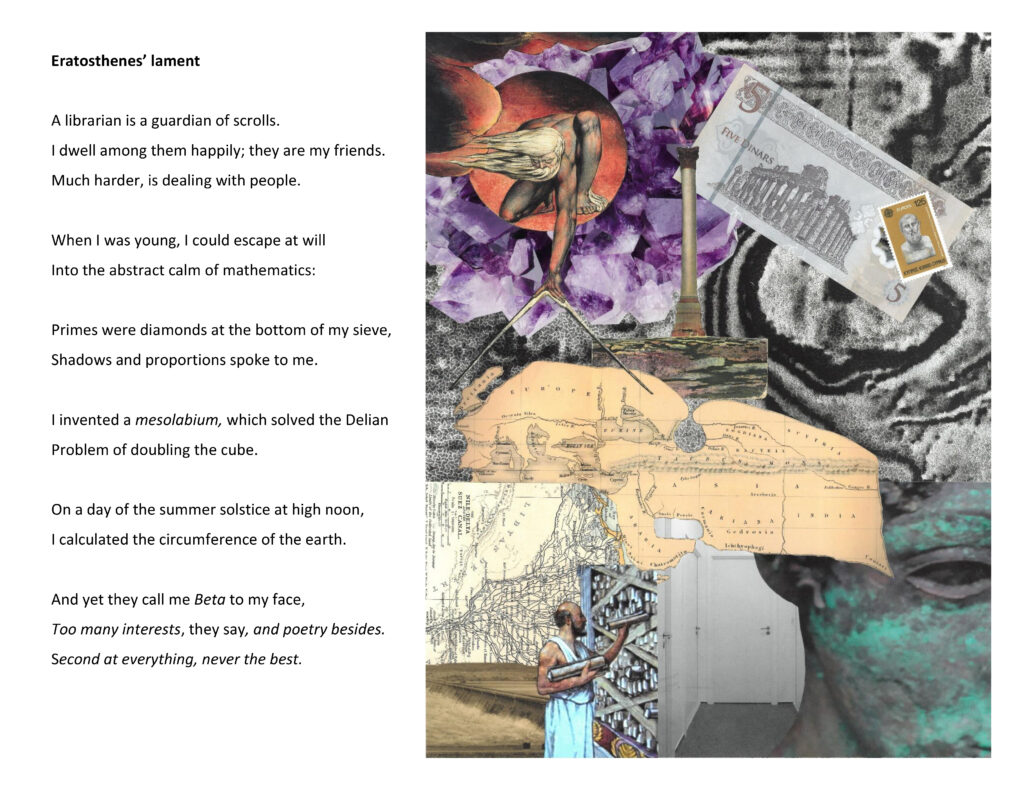
In Greece of that year, there was a mathematician, geographer, astronomer, philosopher, poet, and music theorist named Eratosthenes, who was the first person to calculate the earth’s circumference, which he did with surprising accuracy.
While working as a librarian at the famous Library of Alexandria, he read about a water well in Syene, Egypt (modern day Aswan), that allowed light down into it every summer solstice without casting a shadow on the wall. This inspired him to begin an experiment and stick a pole in the ground in Alexandria to measure a shadow there, some 800 km away.
On the next relevant summer solstice, while there was no shadow being cast in the water well in Syene, Eratosthenes calculated that there was a 7.2-degree shadow from the top of the pole to the ground that the sunbeam created over in Alexandria. He divided 360 (degrees in a circle) into 7.2 to get 50, then multiplied that by the 800 km distance between the two cities.
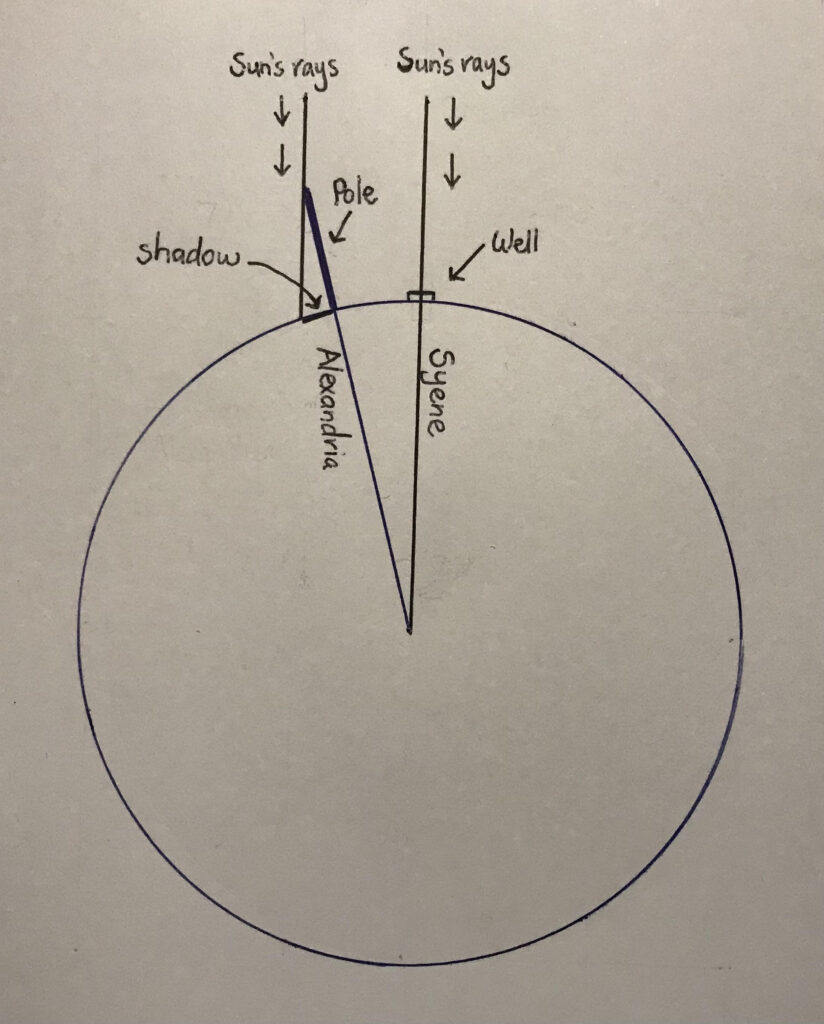
His final measurement of Earth’s circumference was 40,000 km, very close to the actual 40,008 km from pole-to-pole, or 40,075 km around the equator (no, the earth isn’t a perfect sphere).
Since then, celestial globes had also been crafted around this time, but for the purpose of this blog, we’ll be focusing more on terrestrial globes.
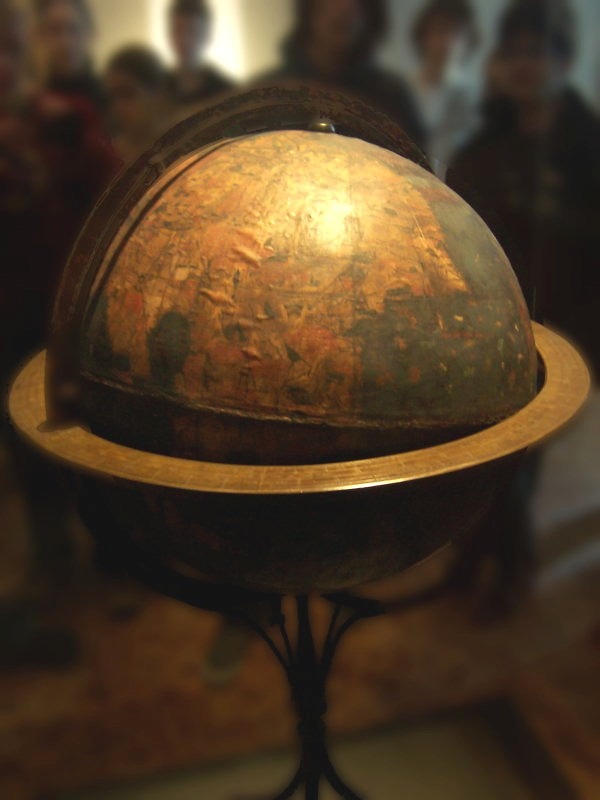
Fast forward to 1492 when the first (and earliest surviving) Eurocentric terrestrial globe was made by Martin Behaim in Nuremburg, Germany. This globe did NOT include the New World, as it predated Christopher Columbus’s return to Spain, which I’ll just call a misguided and terrifying adventure. Behaim’s 1492 globe, called the Erdapfel (earth apple), had many errors, but nevertheless, it was still a feat for its time.
Fast forward yet again to our neck of the woods. Born in Londonderry, NH, in 1763, James Wilson (1763-1855) was a farmer and blacksmith before visiting Dartmouth College as an adult. He encountered European Globes there and became fascinated by them. He ended up obtaining an 18 volume Encyclopedia Brittanica, became self-taught in cartography and geography, and moved to Bradford, VT, in 1796. From there he studied at the Bradford Academy and made his first rudimentary globe around that time.
This rudimentary globe was a large wooden sphere which James covered with paper and drew on with pen and ink. He was a long way off from creating something more extraordinary, and he knew this. Further study and materials were needed. After some trips to surrounding states for education and materials over the following years, James was on his way! It took him 300 days working on a copper plate to get everything just right and for all the details to match up perfectly. In the area of 1809-1810, he had fewer than 20 globes which he was selling in the Vermont area.
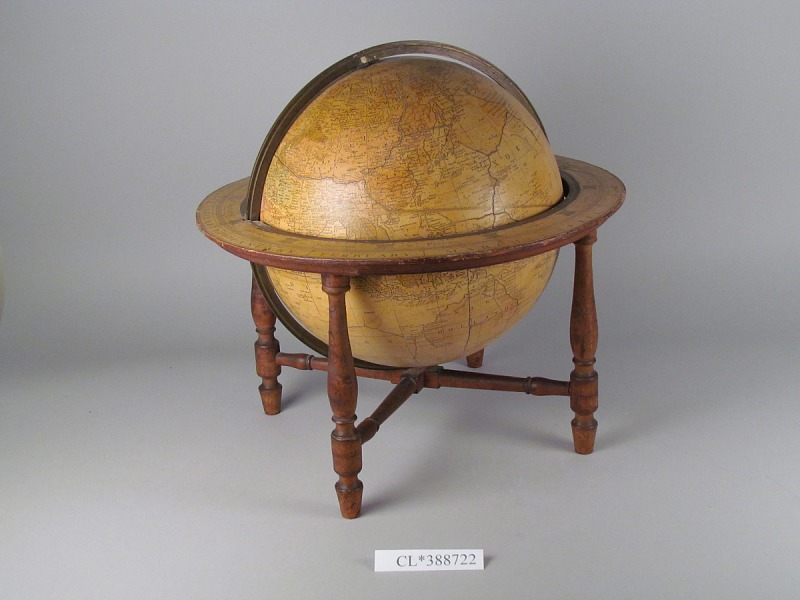
By 1813, he had his “perfected edition” globes that he introduced to the Boston area, for which there was a great demand. From there, demand spiked even further. By 1815 (exact year uncertain), he opened a manufacturing plant in Albany, NY, as James saw this as a strategic sales location.
Three of his three sons took care of operations there for several years. James preferred to stay in Bradford, VT, for the most part, while his sons continued work in Albany. Between 1827-1833 however, all three sons died for different reasons, leaving a colleague Cyrus Lancaster to oversee operations.
1827 was a year where Wilson’s globes went national, and celestial and terrestrial globes were sold in pairs by the company to rich folks and schools/colleges for use.
The rest is history as globes became more commonplace and were found in many homes by the early 20th century due to mass production.
James Wilson lived to the ripe old age of 92 years and died in Bradford in 1855. He was married three times and had 14 children in total between the three marriages, though not all the children lived to maturity.
Researching and writing about this story inspired me to look more at geography and cartography, as it really is fascinating to look at all “corners” of the world to see all the places I would love to go to (and have forgotten about) but will never have the opportunity to visit.
I can only speculate on what cultures are like in each location, and how the people who live there perceive life and what their thoughts are on pretty much anything. As much as I consider myself to be a hermit, I do appreciate a good conversation and learning about other people and what makes them tick.
When I was young, I remember spinning a globe at school just to see where my finger would land. As the earth is 71% water, you’d be lucky if your finger stopped on a land mass, but it was still fun, nonetheless. There’s a chance we might buy a globe now so we can share this experience with our daughter!
I would love to hear your thoughts on your varied cultural experiences from your travels around the world in the comment section below!

Your mom
Vinnie, we still have that globe you put your finger on when you were younger. I remember you doing this!
Vinnie
I remember! It’s time to pass that tradition down the line.
Sarah DiBernardo
I love this subject! I find maps to be very fascinating and it’s something I can see of myself as it becoming a hobby of reading and collecting them. I do have a bunch of maps that I look at from time to time.
I wonder how the earth measures out now? There’s a dam in China that’s so massive that it’s tilted the earths axis a little bit.
Justin
Sarah, there is no damn way a dam in China tilted the axis of the Earth.