

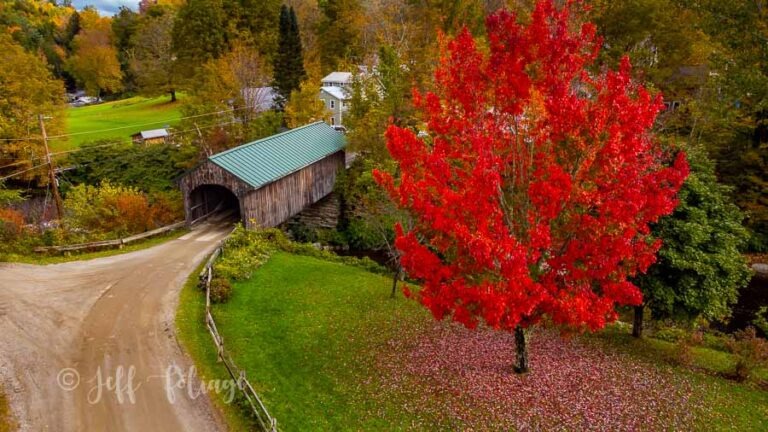
I would be remiss not to dedicate a blog post to the vast number of covered bridges that still exist and get driven over every day in Vermont. I have briefly touched on this subject in my previous post, How to Talk Like a Vermonter and Other New Englanders under the “Covered Bridge” and “I Am Vermont Strong” definitions, however, there is much more to be said on the subject. Please review that blog post to read up on a tragic event that unfolded for the covered bridge I grew up with. For preview, here are before and after photos of said covered bridge.


In that blog post, I state that Vermont currently has over 100 covered bridges, while New Hampshire has 58, Maine has 10, and Massachusetts and Connecticut each have a few (there are also plenty left in other non-New England states as well). It’s important to note that covered bridges were not called that in the early 1800s. They went by other names, such as timber bridges, truss bridges, barn bridges, wooden bridges, kissing bridges, wishing bridges, or simply “bridges.” It wasn’t until they became more widespread throughout the 1840s-1870s that engineering journals and town records began referring to them as covered bridges.
The majority of the covered bridges in the United States were built between 1825 and 1875, with Vermont at one point having over 700. That’s pretty impressive, considering that Vermont is the 6th smallest state in the U.S.! A covered bridge could also be constructed in just a few weeks back in the 1800s, however, it could take much longer, depending on how the foundation was built.
Let’s get into why covered bridges were built in the first place and why they need to be covered:
Early on in Vermont’s settlement, it was very common to build your communities near running water. Watermills were often constructed to grind grains into flour and were just generally a great natural energy source. Learn more about the mechanics of watermills here. Naturally, it would make sense to build bridges near these mills, so that was a common occurrence.
The design of a covered bridge makes it look great, it’s durable, and they certainly are visually beautiful landmarks for tourists to visit and for everyone to drive over. However, the original reasons for their construction were solely practical. In the early 1800s, wood was an abundant, light, cheap, and strong building material. However, wooden bridges required replacement over a span of 10-20 years due to rot and deterioration. This was, of course, before the days of pretreated wood.
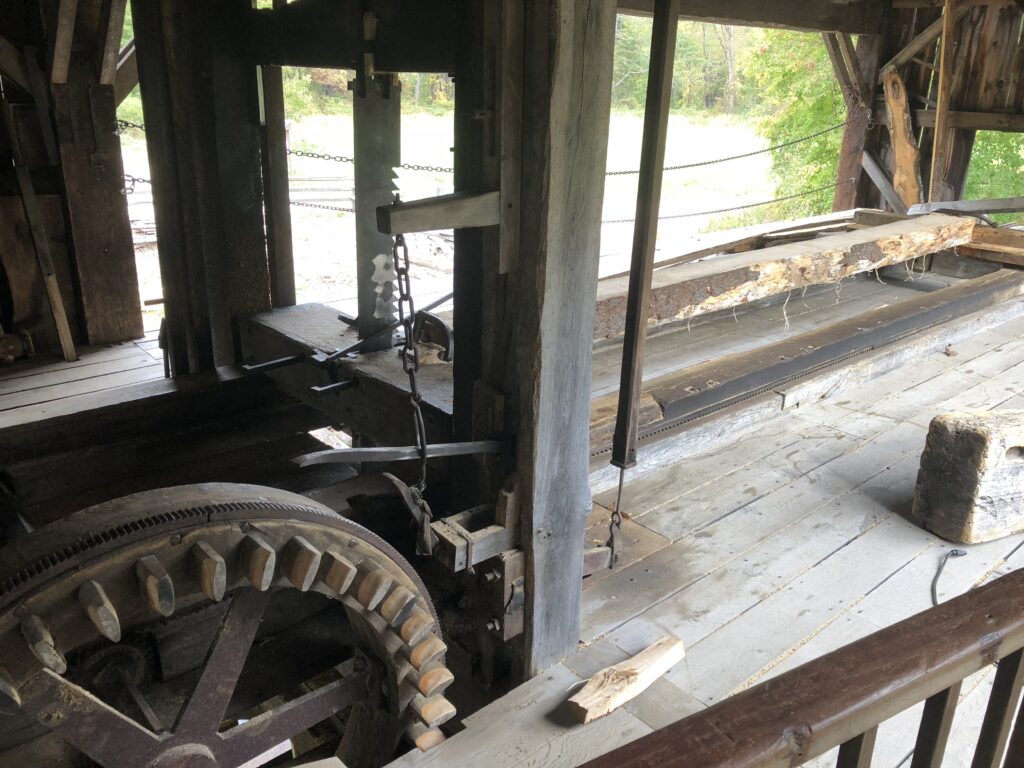
The solution? Roofs. Adding a metal roof with wooden support trusses extended the lifespan of a covered bridge to over 100 years. The roof gave additional support to the truss, which made it possible to build even longer bridges. An additional benefit was for farmers, where the roof and siding would shield the eyes of livestock from the sight of rushing water, keeping them calm enough to cross without stampeding.
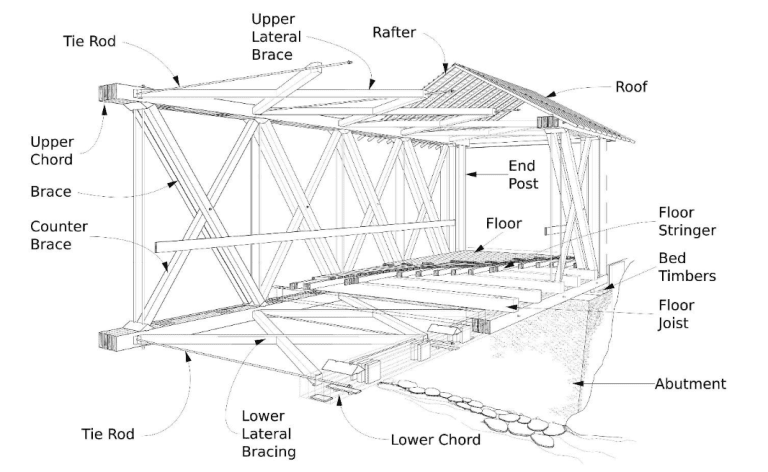
The most common truss (support beam) styles that were patented were named for their designers: the Burr arch truss, the Long truss, the Town lattice, the Smith truss, the Paddleford truss, and the Howe truss. These became the standard for wooden bridges longer than 60 feet. See what some of the truss designs look like, here.

The beauty of covered bridges is more than just about the design or their uniqueness; it’s the history that goes along with them. Sadly, detailed records were not initially kept for the majority of them as they were simply viewed as functional infrastructure at the time and were not considered historical landmarks until the 1930s-40s. In the early 1900s, the introduction of steel, iron, and concrete allowed for the construction of bigger, wider, and longer bridges to be built that could support more weight. Thus, many timber bridges were either destroyed, relocated, retrofitted with steel, or left to rot.
At one point, the United States had around 14,000 covered bridges. Today, somewhere between 500-600 remain. A real shame, considering how beautiful they look and how functional they still are. This is just another example of how “cheap and easy” became the way to go, letting history slowly fall against the backdrop (see what I did there?).
This is more reason why they should be visited, cherished, and admired. I’m hoping that in another 100 years, there will still be some left for the following generations to appreciate. There are also many books on covered bridges online and plenty of information in the links I included in this blog posting if you’d like to learn more about their history.
Thank you for reading! Posts will be far more infrequent going forward as I have started a new job and it takes up a lot of my time, along with being an involved father and husband.
Be well, everyone!

Violet
Wonderful and informative read. As a former Midwesterner, it was odd to move to the north and see covered bridges in many places. I often wondered why there were so many. This article satisfied my curiosity about this local, cultural phenomenon. Many thanks!